Field Tuff
Seeders, harrows, spreaders and rakes for the acreage a lawn tractor outgrew. The 60-inch 3-point seeder plants 10 rows and meters fertilizer on the same pass, and everything around it mounts to a compact tractor, an ATV or a UTV.
Start With the Hitch You Already Have
More Field Tuff returns come from a mismatched connection than from a broken part. Four systems cover the whole range, and they do not interchange.
Category 1, 3-point
Compact and utility tractors
Fits: Seeders, pine straw rakes, cultivators, chisel plows, cultipackers, bedders
Check first: Horsepower is the easy half. A 20 HP rating means nothing if the 3-point cannot lift 485 pounds of empty seeder plus a hopper full of seed and fertilizer, so check the lift capacity printed in the tractor manual.
Sleeve hitch
Garden tractors and small lawn tractors
Fits: The FTF-811DHSH disc harrow and other sleeve-hitch implements
Check first: A sleeve hitch is not a 3-point hitch and the two do not interchange. On many garden tractors it is a separate accessory that was never fitted at the factory, so look under the rear end before ordering.
2 in. ball, tow behind
ATVs, UTVs and lawn tractors
Fits: Drag harrows and chain rake leveling drags
Check first: The lightest way into field work. There is no lift, so the implement drags at all times and has to be pulled clear of anything it can snag before you turn.
1-1/4 in. and 2 in. receiver
ATVs, UTVs and side by sides
Fits: The AS-80ATV12 12V broadcast spreader and hitch-mount gear
Check first: The spreader also needs 12V power. Plan where the harness runs and where the switch ends up before the hopper is loaded, because reaching behind the seat at 8 mph is not a plan.
Field Tuff Equipment
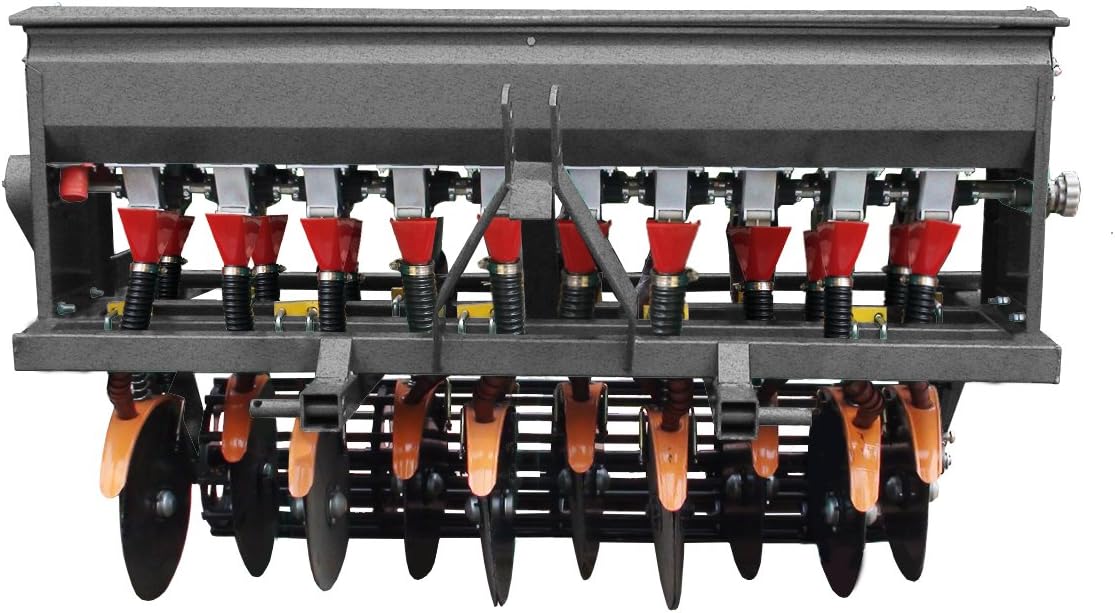
FTF-603PTS
Field Tuff 60-Inch 3-Point Seeder
Plants 10 rows in one pass and meters seed and fertilizer through separate paths.
- 60 in. working width, 10 rows at 6 in.
- Sowing depth 3/4 in. to 2 in.
- Category 1, 20 HP minimum, 485 lb.
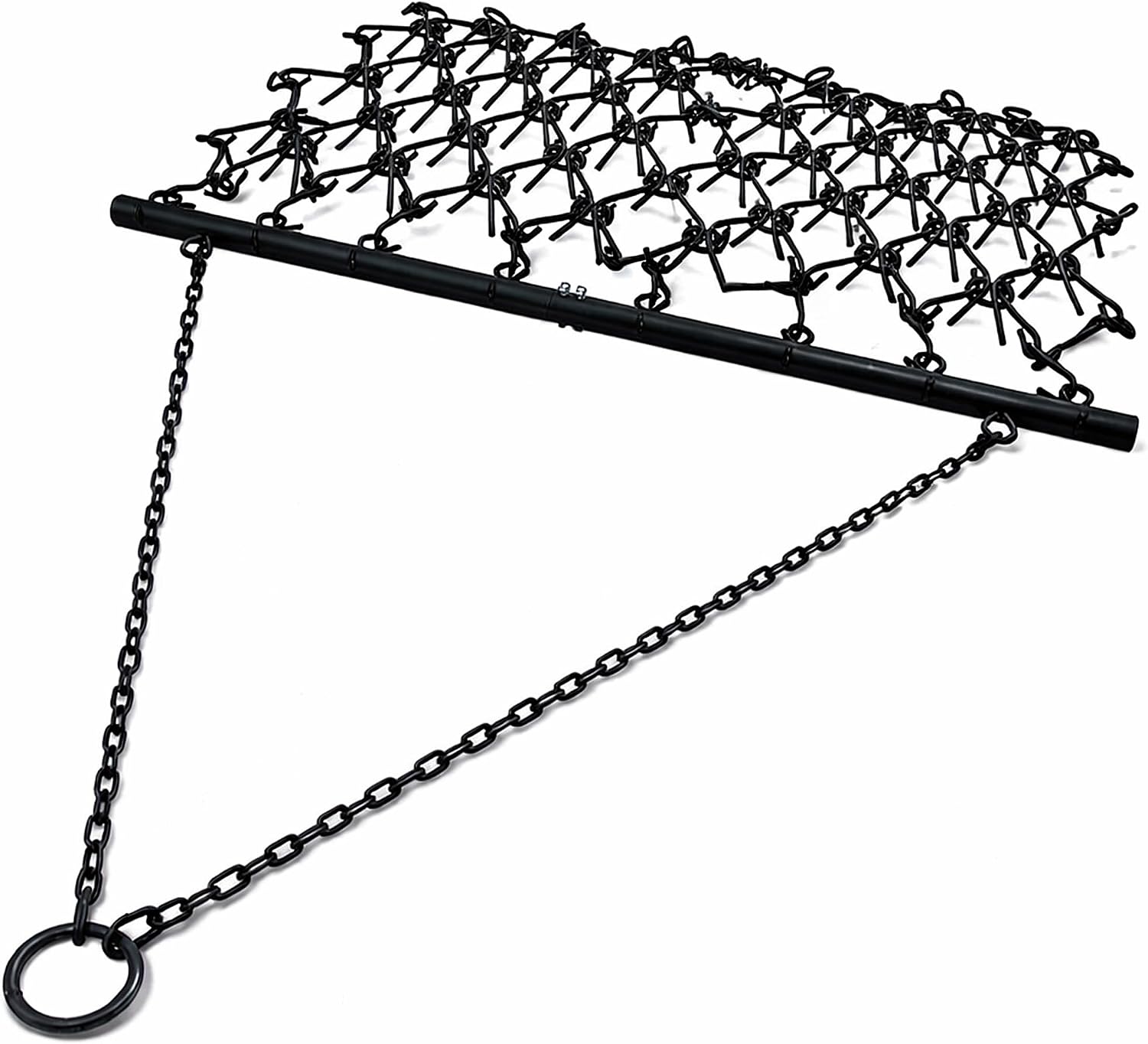
HDHA-64
Heavy-Duty Drag Harrow, 6 x 4 ft.
Knocks down clods and manure piles, refreshes gravel and levels loose soil behind an ATV or lawn tractor.
- 97 tines, 14 hooks, 1/2 in. teeth
- Pulls from a 2 in. ball
- Flip it over for a gentler pass
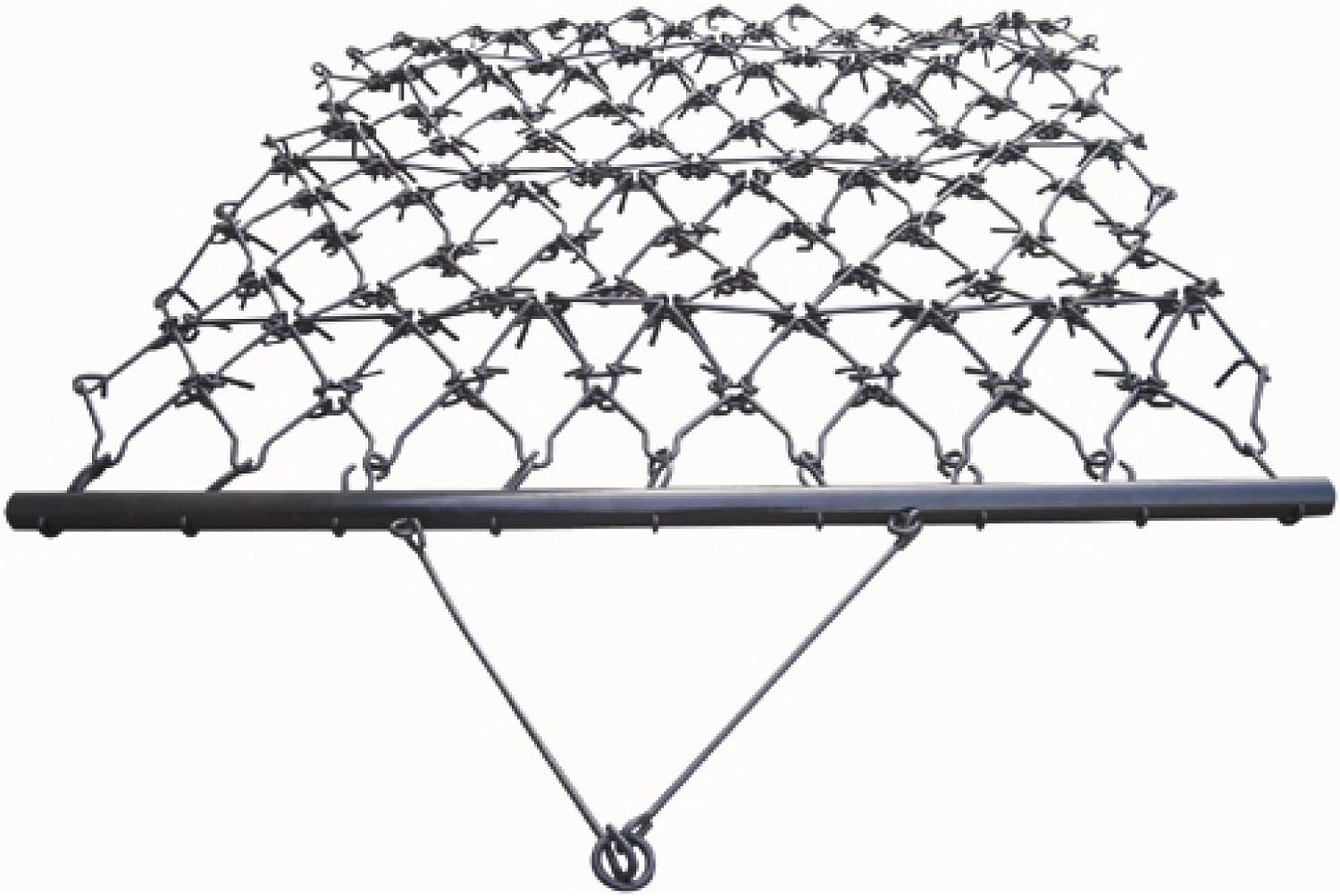
4 ft. chain drag
Chain Rake Field Leveling Drag, 4 ft.
The narrow drag for arenas, small plots and paths that a 6 foot mat cannot turn around in.
- 4 ft. working width
- Steel chain mat with fixed tines
- ATV, UTV and lawn tractor
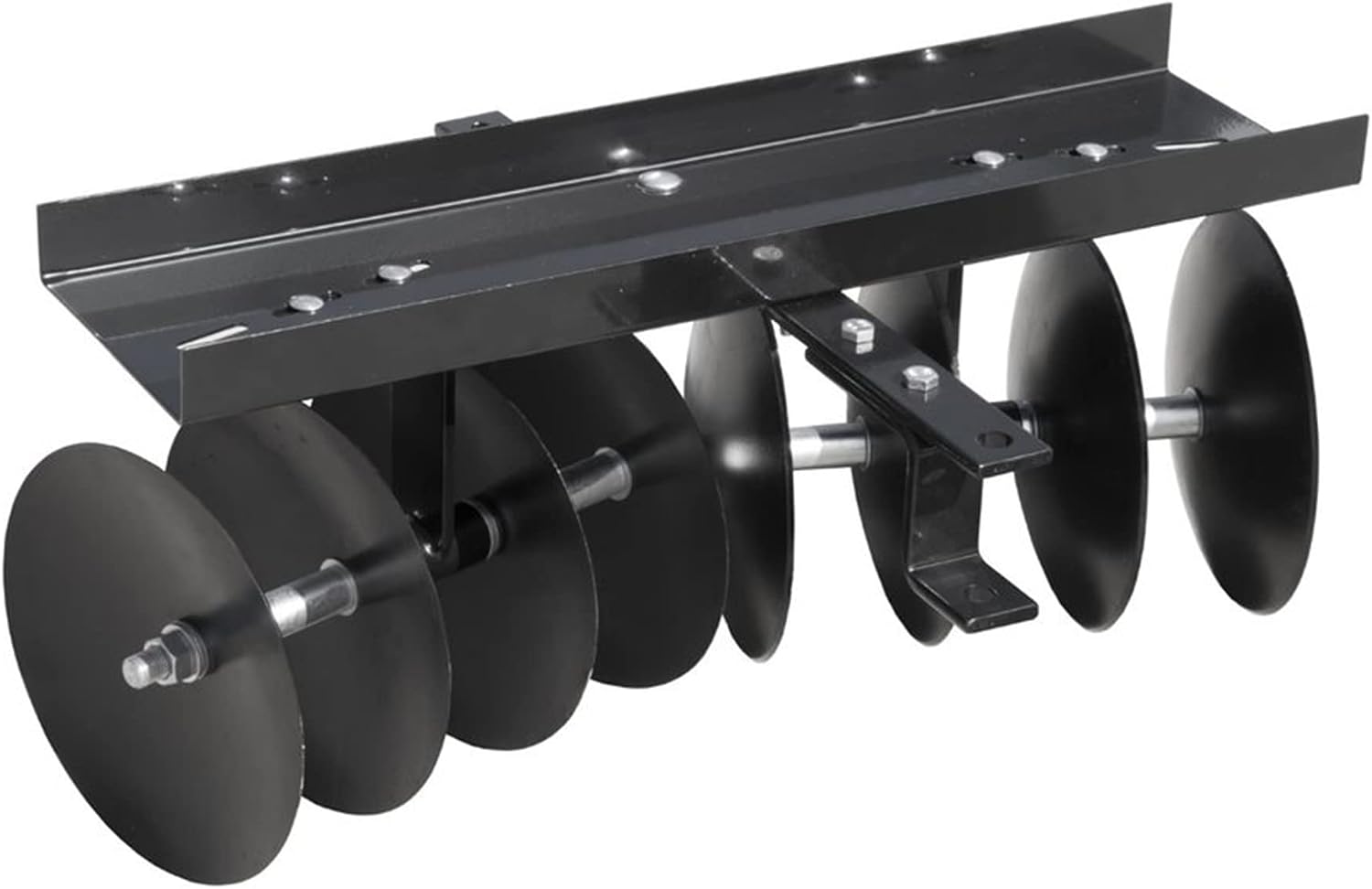
FTF-811DHSH
Sleeve Hitch Disc Harrow
Cuts and turns rough ground so a seeder has something to work with.
- Eight 11 in. steel discs
- Up to 39 in. working width
- Disc angle at 10, 15 or 20 degrees
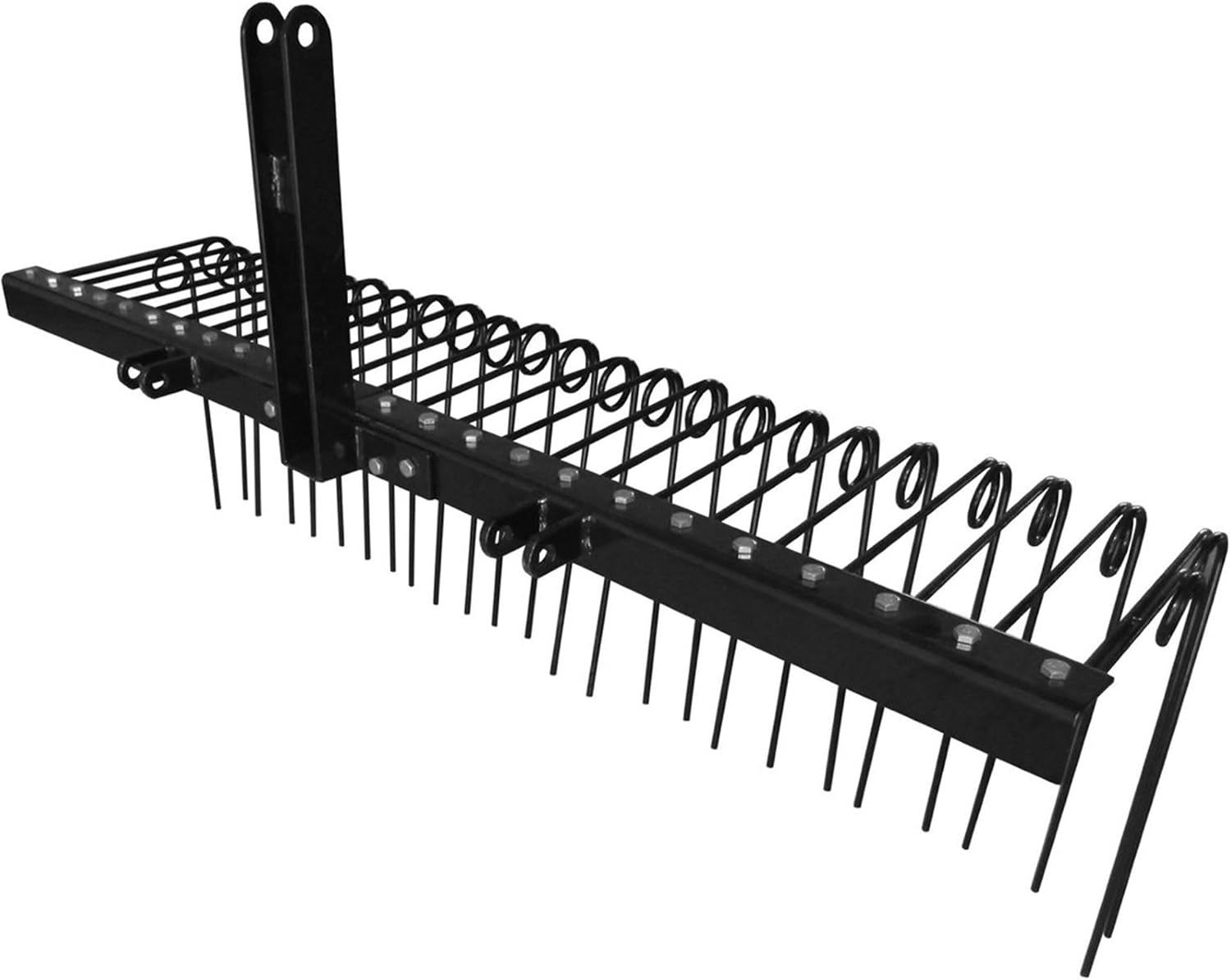
FTF-60PSR3PT and tow-behind versions
Spring Coil Tine Landscape Rake
Gathers pine straw, leaves, cut grass and loose landscape debris across a full 60 inches at a time.
- Coiled spring steel tines that flex
- 60 in. and 72 in. widths
- Surface cleanup, not tillage
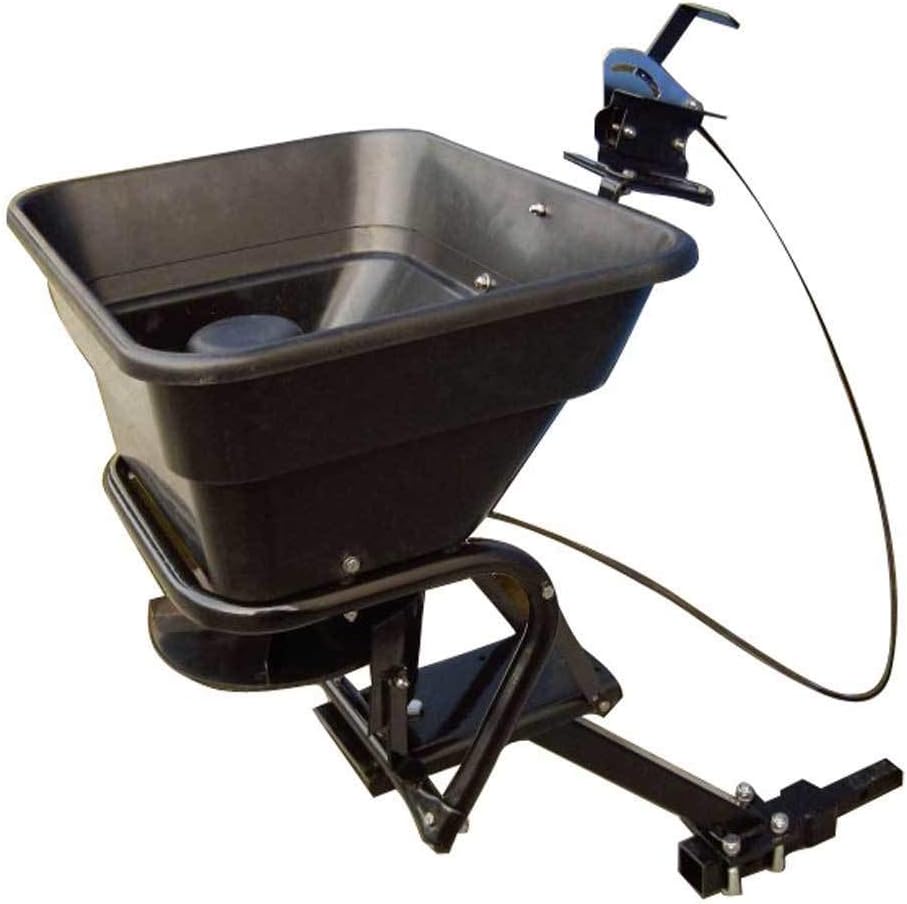
AS-80ATV12
12V Hitch-Mount Spreader, 80 lb.
Broadcasts grass seed, granular fertilizer and small grain across the surface at about 6 feet a pass.
- 80 lb. or roughly 8 gal. poly hopper
- 12V motor, harness and switch included
- Fits 1-1/4 in. or 2 in. receivers
The 60-Inch Seeder in Detail
Seed and fertilizer stay apart
The hopper splits front to rear. Fertilizer rides in the front compartment, seed in the rear, and each one runs through its own metering path. Twenty funnels and hoses carry the two materials down to the coulters, where the front opening takes fertilizer and the rear opening takes seed.
That separation matters when the two application rates differ, which they usually do. It also keeps a damp fertilizer from bridging across a hopper full of seed. Hardware on the machine is not stainless, so rinse and dry the fertilizer side at the end of the day.
One pass, four jobs
Ten double-disc coulters cut the prepared soil open. Seed and fertilizer drop through their separate openings, and the rear of the machine rolls and drags the row closed behind them.
Set up correctly, the FTF-603PTS opens, places, rolls and covers on the same trip across the field. Set up carelessly, it does the first two and skips the rest, which is why the depth adjustment on both sides has to match.
| Specification | FTF-603PTS |
|---|---|
| Working width | 60 in. |
| Planting rows | 10 |
| Row spacing | 6 in. |
| Sowing depth | 3/4 in. to 2 in. |
| Hitch | Category 1, 3-point |
| Minimum rated tractor power | 20 HP |
| Implement weight | 485 lb. empty |
| Operating speed | 1 to 3 mph |
| Coulter assemblies | 10 double-disc |
| Hopper | Separate seed and fertilizer compartments |
| Seed and fertilizer rate | Mechanically adjustable |
| Warranty | 1-year limited parts |
Three working widths
| Model | Working width | Rows | Row spacing | Planting depth |
|---|---|---|---|---|
| FTF-483PTS | 48 in. | 8 | 6 in. | 3/4 in. to 2 in. |
| FTF-603PTS | 60 in. | 10 | 6 in. | 3/4 in. to 2 in. |
| FTF-843PTS | 84 in. | 14 | Wider frame | Up to 2 in. |
All three mount to a Category 1 3-point hitch. Width is not the only question: a wider machine cuts passes across open ground but wants more room at gates, plot edges and tree lines, and it asks more of the tractor every time it comes off the ground.
A Seeder for Prepared Soil, Not a No-Till Drill
The FTF-603PTS is rated for level or gently rolling fields that have already been worked. Rocky ground is hard on it, and standing sod stops it.
Open the ground
Sod, heavy residue and packed clay stop the coulters before they reach depth. A disc harrow, cultivator or tiller does that work first, and skipping it is the reason most row seeders get blamed for planting nothing.
Disc harrow or cultivator
Level what you broke
Fresh tillage leaves clods and ruts, and a coulter riding over a clod places seed on top of the soil instead of in it. A drag harrow pulls the high spots into the low ones.
Drag harrow or chain drag
Plant and fertilize together
Load fertilizer in the front compartment and seed in the rear, set the depth, then hold 1 to 3 mph across the field. The rear of the machine rolls and covers the row as it goes.
FTF-603PTS seeder
Finish the surface
Small seed sown shallow benefits from firm contact with the soil around it. Another light drag pass, or a cultipacker, presses the seedbed back down after the seeder has been through.
Drag harrow or cultipacker
Before the crate is opened
The 60-inch seeder ships in a steel crate, upside down, at over 500 pounds. Getting it off the truck and flipped upright takes a loader, a forklift or several people who owe you a favor, and freight carriers deliver to the curb rather than the barn.
The machine arrives assembled, but the funnels and hoses travel loose inside the hopper and have to be fitted. Fertilizer hoses go to the front coulter openings, seed hoses to the rear. Getting that backwards puts the fertilizer where the seed should be.
Calibrate to the Seed, Not the Dial
A rate setting is a repeatable machine position. It is not a promise of pounds per acre.
Zero every meter first
Run the hand wheels back to zero and confirm all the metering wheels close by the same amount. One that sits open by a hair puts a heavy row next to nine correct ones, and you will not see it until the crop comes up.
Set the opening, then test it
Open the meter to a starting position for the material you are using. Leave one outlet running, cover the area under it, and roll about 30 feet so the discharge can be collected.
Weigh or count what came out
Work the collected sample back to pounds or seeds per acre, compare against the target from your seed supplier, and move the opening from there. Two test runs beat one guess by a wide margin.
Redo it when the seed changes
Seed size, weight and moisture all change how much material passes the meter, and so do fertilizer granule size and humidity. A setting that was right for the lot you ran last season is only a starting point for this one.
Depth, both sides equal
The rear roller position sets sowing depth anywhere from 3/4 inch to 2 inches, locked by wing nuts. Uneven depth almost always traces back to an out-of-level frame or one side adjusted further than the other, so level the 3-point linkage before suspecting anything else.
Speed does the rest
Hold 1 to 3 mph and avoid stopping mid-row. Lower the implement only while moving forward, and raise it before you reverse or turn sharp. Coulters forced sideways through soil bend, and bent coulters plant at whatever depth they feel like.
Watch the chain drives
Seed drops because the chain drives turn. Glance back often enough to catch a jumped chain, or you can finish several rows that planted nothing at all. Residue wrapped into the drive cogs is the usual culprit, so mow woody stems down before seeding into them.
What Owners Report From Their Own Fields
This unit is cheap! Like way cheap. If you’ve priced seeders you know that this is a fraction of the cost of its nearest competitors. I’ve owned mine for 2 years, I’ve paired it up with a 15hp 2WD gray model Ku...
R. Kellogg
If you bought a seeder and expected it to function as a drill you are an idiot, this seeder is built for delivering seed to a prepared bed. The owner's manual is pretty clear. I bought this with no illusions as...
37 Packard
I have 5 acres, including 2 acres of pasture, multiple yards, and a long gravel driveway. Everything is in rough shape with bumps, high and low spots, mounds, etc. I bought this primarily to drag the pasture an...
AJ
I go through harrows like candy because my “roads” are gravel sand and rock. This is my first one of this brand. Assembly is basic - attach drawbar and chain. The drawbar is a two piece tube rather than a piece...
James A. Lang
OK, so I will start right off by saying I was not prepared for the weight of this drag. I thought there was no way our little 90 cc Can Am quad could tow this thing. Well it can and cant, it will tow both piece...
Kevin
I received it in a timely manner. It was fairly simply to assembly.The only thing I changed was the type of connection for power. I took off the supplied ring type leads and replaced them with alligator clips....
Aaron Jones
Parts, Warranty and Wear Items
What the warranty covers
A one-year limited parts warranty comes with the FTF-603PTS seeder, the AS-80ATV12 spreader, the FTF-60PSR3PT rake and the FTF-811DHSH disc harrow. Terms shift between models and sellers, so read the coverage on the exact product before you order.
What it does not
Normal wear, improper assembly, misuse and damage from running an attachment outside its intended job fall outside coverage. Seed tubes, tines, discs and chains are wear items on any implement in this class and get replaced on a schedule the soil sets.
Missing or damaged on arrival
Freight damage, a short hardware bag or a part missing from the crate all go through Amazon, and the order record already sits on your account. Photograph the crate before you break it down.
Keeping a seeder running
Lubricate the chain sprockets, shafts and friction points every four working hours. Keep the lubricant off the chain itself and off the discs, where it collects soil instead of shedding it. Check bolts, chain tension and sprocket alignment before each field rather than after a failure.
Empty the hopper when the field is done. Fertilizer left inside pulls moisture out of the air and goes to work on the hardware, which is not stainless. At the end of the season the funnels and hoses come off and store inside the hopper where they cannot get crushed.
Replacement parts, warranty claims and repair questions for an Amazon purchase run through Amazon support, where the order and seller are already attached to the case.
About Field Tuff
Field Tuff has been in the US agricultural equipment market since the late 2000s. The FIELD TUFF trademark, held by Tri Global Enterprises, Inc., lists first use in 2009, first commercial use in 2010 and federal registration in 2011, covering cultivators, tillers, disc harrows, seed planting machines, tractor-towed harrows and related hitch equipment.
The line has kept the same practical shape since. Seeders cover compact and wider Category 1 applications. ATV and UTV attachments handle spreading and tow-behind work for properties with no tractor at all. Tractor implements take on soil preparation, field finishing, raking and hauling.
What that adds up to is equipment aimed squarely at the space between hand-operated lawn tools and large commercial farm machinery: private acreage, small farms, hunting properties, food plots and the ordinary jobs a rural property hands you every season. The price reflects that position, and so does the build. Owners who get the most out of these machines treat setup and adjustment as part of the work rather than a defect.
Choose around the job already on your property instead of building a setup around one attachment. A new food plot needs the ground broken before anything gets planted. A pasture that only needs dragging every spring does not need a seeder at all.
Frequently Asked Questions
Field Tuff is an agricultural and acreage equipment brand built around tractor, ATV and UTV attachments for planting, soil preparation, spreading, grading, raking and general property maintenance. The range covers 3-point seeders, disc harrows, drag harrows, spreaders, cultivators, landscape rakes and related utility equipment. The FIELD TUFF trademark lists first use in 2009 and first commercial use in 2010 for agricultural machinery and tractor-towed equipment.
The FTF-603PTS is a 60-inch 3-point seeder that plants 10 rows across prepared ground at 6-inch spacing, with planting depth adjustable from 3/4 inch to 2 inches. It handles corn, beans, oats, wheat, rye, grass seed and compatible food plot mixes. Meter settings should be calibrated for the specific seed being planted rather than copied from a chart.
It connects to a Category 1 3-point hitch and is rated for tractors of at least 20 HP. The seeder weighs roughly 485 pounds before any seed or fertilizer goes in, so check 3-point lift capacity alongside horsepower. A tractor can clear the horsepower requirement and still lack the hydraulic lift for the fully loaded implement.
Ten rows at once, spaced 6 inches apart across the 60-inch working width. That lets a compact or utility tractor cover far more ground per pass than a single-row planter while staying narrow enough for most food plots, gardens and small fields.
The current 3-point seeders plant 8, 10 or 14 rows at 6-inch spacing rather than two wide rows, so they are drill-style seeders rather than row-crop planters. Individual seed tubes on the FTF-603PTS can be shut off, which widens the effective row spacing when a crop needs more room between rows. For true 30-inch row-crop corn with precision singulation, a dedicated vacuum planter remains the right machine.
Yes. The hopper is divided front to rear, with separate metering for each material. Fertilizer loads into the front section and seed into the rear, and each one follows its own funnel and hose down to the coulter assembly. Both go into the ground on the same pass without ever mixing inside the hopper.
Seed output changes mechanically, by opening or closing the metering system with the hand wheels on the hopper. No single setting is accurate for every seed, because size, weight, shape and moisture all affect how much material passes the meter. Pick a starting position, make a measured test run, collect the discharge and adjust until the output matches your target rate or plant population.
From about 3/4 inch to 2 inches, set through the rear roller adjustment. Choose the depth for the crop, the soil condition and the seed supplier recommendation. Larger seed generally goes deeper than small grass or forage seed, and the full 2 inches is wrong for plenty of crops.
No. It is built for prepared soil. The double-disc coulters work well once hard ground, sod or heavy residue has been dealt with, and poorly. A disc harrow, cultivator or other tillage attachment usually needs to run first when the ground is compacted or carrying established vegetation.
Between 1 and 3 mph. Holding a steady speed keeps metering and seed placement consistent, and slowing down solves more problems than it causes. Raise the seeder before reversing or making a sharp turn so the coulters are never forced sideways through the soil.
Yes, in several widths for Category 1 tractors. The FTF-483PTS covers 48 inches with eight rows, the FTF-603PTS covers 60 inches with 10 rows, and the FTF-843PTS covers roughly 84 inches with 14. Tractor lift capacity, field size, gate and access width and the room you have to turn all decide which one fits, not acreage alone.
A seeder places material into defined rows and controls how deep it goes. A broadcast spreader throws seed or fertilizer across the surface and leaves it there. Use the FTF-603PTS when row placement and depth matter. The AS-80ATV12 12V spreader suits jobs where grass seed, granular fertilizer or another compatible material simply needs to cover a wide area.
An 80-pound hopper capacity, roughly 8 gallons of compatible material. It runs grass seed, fertilizer and suitable small grains off a 12V motor and mounts to common 1-1/4 inch or 2 inch receivers on ATVs, UTVs and utility vehicles.
Leveling loose ground, breaking up clods, smoothing prepared soil and redistributing surface material. They earn their keep after rough soil preparation and on fields, plots, arenas and gravel surfaces that need maintaining. A drag harrow will not replace a disc harrow or powered tiller when hard, compacted soil has to be cut deeply before planting.
Loose surface material such as pine needles, leaves, straw and cut grass. The 60-inch FTF-60PSR3PT connects to a Category 1 3-point hitch and uses flexible spring steel tines to gather material across a much wider strip than a hand rake. It is a cleanup and landscaping attachment, not a tillage implement.
Many Field Tuff products carry a one-year limited parts warranty, including the FTF-603PTS seeder, AS-80ATV12 spreader, FTF-60PSR3PT rake and FTF-811DHSH disc harrow. Coverage varies by model and by seller, so check the terms on the specific product before buying. Normal wear, improper assembly, misuse and damage from running an attachment outside its intended application are commonly excluded.

Get the Field Ready
Match the implement to the hitch on the machine you own and the job the ground actually needs. Break new ground with a disc harrow, level it with a drag, then plant 10 rows and place fertilizer on the same pass with the 60-inch seeder.
Shop Field Tuff on Amazon